Wildfire-Resistant Siding in BC: FireSmart Principles for Your Exterior
How siding and exterior choices change wildfire outcomes in BC: FireSmart principles applied to cladding, the ember problem, material rankings, detailing that matters and insurance context.
Every BC summer now carries a smoke season, and every few years a community the province knows by name learns what interface fire means. The Lower Mainland is not Lytton, but its edges, the forested slopes of Maple Ridge and Mission, the greenbelt ravines of Coquitlam and Surrey, the North Shore's mountain streets, are wildland-urban interface by any definition, and exterior choices there now carry a fire dimension alongside rain and looks. This guide applies FireSmart thinking to the siding conversation, part of our siding guide for BC buildings.
How houses actually ignite: the ember problem
The mental model most people carry, a wall of flame arriving at the siding, is the rare case. The overwhelming driver of structure loss in interface fires is embers: burning fragments lofted kilometres ahead of a fire front, arriving in wind-driven showers that probe every detail of a building for somewhere to lodge and smoulder. Post-fire investigations repeat the same findings: homes ignite at debris-filled gutters, at vents that inhaled embers, at bark mulch against walls, at fence lines that carried flame to the cladding, at the dry leaves under a deck, far more often than through the field of the wall itself.
That reframing changes the siding conversation productively. Cladding material matters, a non-combustible wall refuses the ember its foothold, but material is one line in a defence that is mostly details: what the wall meets at its base, how its vents are screened, where its junctions collect debris, what stands against it. Which is to say: fire resistance is an exterior system property, exactly like rain resistance, and it is bought the same way, through material choice and detailing discipline together.
Ranking the claddings by fire behaviour
Non-combustible tier. Fiber cement leads the practical list: mineral boards that do not ignite or feed flame, available in every mainstream look including convincing woodgrain, at premium-but-attainable cost, the reason it dominates rebuild programs in fire country. Metal cladding shares the class: steel and aluminum systems do not burn, and their panel formats protect large elevations cleanly, with Longboard-style woodgrain supplying the warm look in aluminum. Stucco and masonry veneers round out the tier.
Combustible-but-rated tier. Engineered wood products carry treatments and ratings, and behave far better than untreated lumber, but remain combustible, the fire line in our Hardie-versus-SmartSide comparison that interface properties should weigh heavily. Natural wood, cedar's beauty notwithstanding, is fuel, and on interface lots it asks for compensating discipline everywhere else.
The melt tier. Vinyl deserves its own honest paragraph: it may not sustain flame aggressively, but it softens, melts and falls away at relatively modest radiant heat, undressing the wall's sheathing and membrane exactly when protection matters. On interface properties this failure mode, more than ignition itself, is vinyl's disqualifier; in the urban core it remains the economical workhorse it always was. Location decides.
The details that decide outcomes
Applying FireSmart's zone logic at cladding scale, here is where exterior fire performance is actually won.
The ground metre. Walk it right now, it takes ninety seconds: is there bark mulch, leaf litter, a doormat of dry debris, or stored anything touching your walls? The wall's base is its most attacked detail: embers accumulate where wind drops them, against walls, and ignite what they find. Non-combustible ground cover, gravel or hard surfacing rather than bark mulch, against the building, cladding clearances maintained, and no firewood, fence ends or stored combustibles touching the wall. A non-combustible skirt zone, fiber cement, metal or masonry for the lowest portion, hardens the most vulnerable band even under wood-look walls above.
Vents and openings. Soffit, gable and crawlspace vents are ember inhalers unless screened to fine mesh standards; ember-resistant venting is among the highest-value upgrades per dollar on any interface home, and it pairs naturally with soffit work, the moment those vents are already in hand.
Junctions and collection points. Roof-wall intersections, deck ledgers, trim ledges and inside corners collect needle litter that becomes wick fuel; design them cleanable and keep them clean. Gutters full of dry debris are pre-laid fire starters at the wall head, the maintenance habit that storm-season audits already preach, doing double duty.
Attachments. Fences, gates, trellises and decks are flame bridges: a wood fence tied to the wall delivers any fence fire directly to the cladding. Non-combustible final sections at the house, metal gate panels, masonry posts, break the bridge for trivial cost.
Windows. Radiant heat breaks single glazing early; tempered and multi-pane assemblies resist longer, worth knowing when window and full-exterior projects coincide.
The interface homeowner's sequence
For an owner on a forested edge deciding what to actually do, the priority order that buys the most protection per dollar, consistent with FireSmart BC's home-assessment approach. First, the free tier: relentless debris hygiene, gutters, roof valleys, wall bases, under decks, and combustibles moved off the wall, mulch swapped for gravel in the ground metre. Second, the modest tier: ember-resistant vent screening, non-combustible fence sections at the house, and the wall-base skirt hardening above. Third, the project tier: when re-siding is on the table anyway, choose the non-combustible tier, fiber cement or metal, and detail the base, vents and junctions to the standards above while the wall is open; the fire premium over ordinary re-siding is small exactly then. Fourth, the whole-property tier: vegetation management outward through FireSmart's zones, beyond this guide's cladding scope but decisive in the assessments the program offers, and worth the site visit many BC communities now provide free.
Insurance sits alongside the sequence rather than driving it: brokers increasingly ask interface-relevant questions, and documented mitigation, materials, photos, assessment participation, positions a property well in markets that have grown selective. The documentation habit this series recommends everywhere earns one more return here.
What the ember research keeps finding
The evidence base behind all of this is worth a section, because it is what separates FireSmart's priorities from folklore. Post-fire structure investigations, the case-by-case forensics after interface losses across western North America, converge on findings that reorder homeowner intuition. Structures ignite overwhelmingly at their receptive fuels, accumulated debris, combustible mulch, stored materials, attached wood features, rather than by radiant heat through walls; homes with hardened details survive inside neighbourhoods where landscaping burned to the foundation line; and survival correlates more strongly with the immediate zone's condition than with distance to the forest, which is why the ground metre owns its priority ranking. Vent behaviour appears constantly: unscreened or coarse-screened vents admit embers to attics and crawlspaces where ignition proceeds unseen, the finding behind the fine-mesh standards. And the window record supports the glazing note above, radiant breakage creating entry points before any flame arrives. None of this is exotic reading, FireSmart BC distills it into its guides precisely so homeowners can act on conclusions rather than folklore, but knowing the findings exist changes how seriously the checklist reads: every line item above is a repeated cause of a real loss, prioritized by body of evidence rather than by what looks impressive in a brochure.
The look you do not have to give up
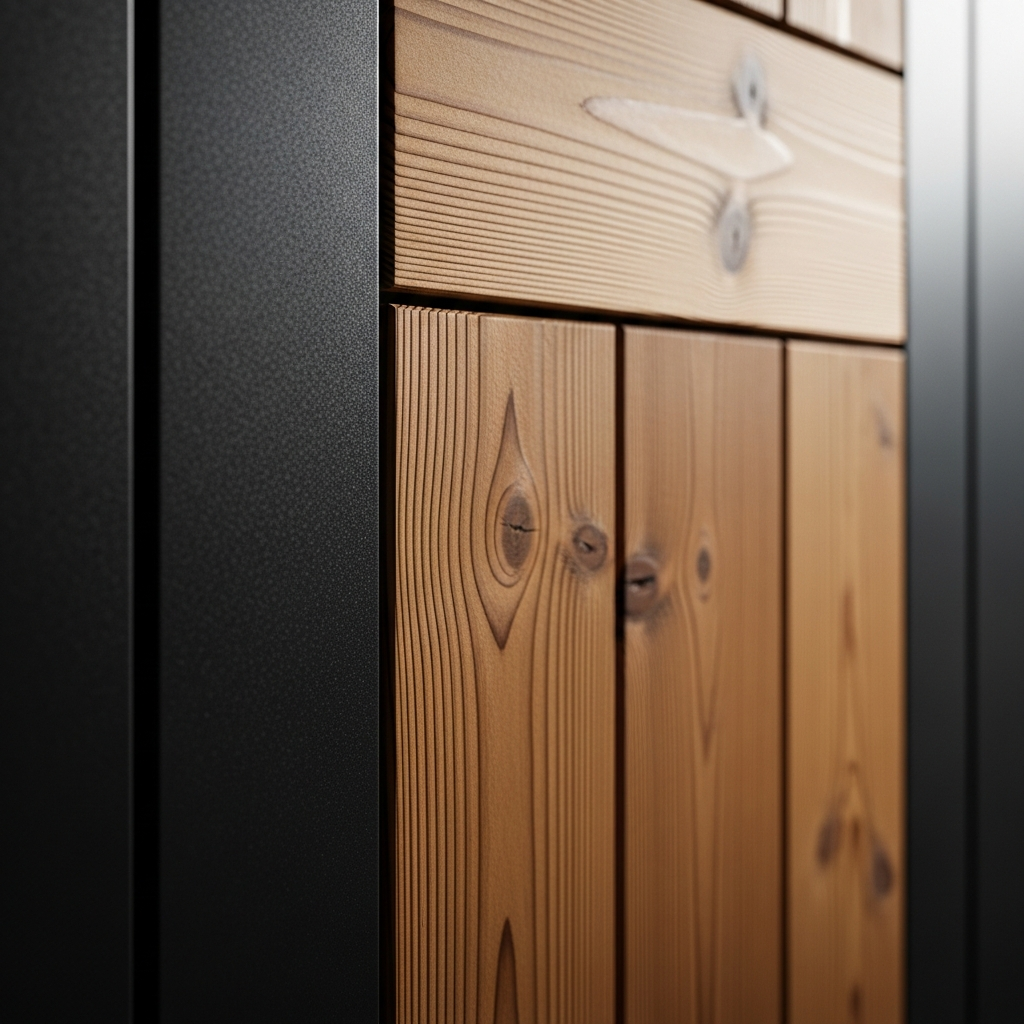
The historical objection to fire-hardening, "I want a warm house, not a bunker", died with modern product lines, and it deserves a burial notice. Woodgrain fiber cement carries cedar's look in a mineral board; woodgrain aluminum does it in metal, at the premium tier; board-and-batten, shingle and every traditional pattern exist in non-combustible versions, per our vertical-siding guide; and the dark-modern palettes the region loves are native to both families. On today's menu, fire class and aesthetics are independent axes. An interface home can look entirely west coast and refuse embers everywhere it counts, which is exactly the combination we build.
What a FireSmart assessment visit involves
Demystifying the program helps more people use it. FireSmart BC's home-assessment approach, offered free through many BC communities and local fire departments, walks a trained assessor around your property scoring the zones: the structure's materials and details, the immediate non-combustible zone, and the managed vegetation rings outward. The output is a prioritized report, not a compliance order: your property's specific ember vulnerabilities ranked by risk and cost, which typically surfaces exactly the details this guide catalogues, the mulch against the wall, the unscreened gable vent, the fence tied to the cladding, alongside vegetation work beyond our trade. Interface homeowners in Maple Ridge, Mission, Anmore and the North Shore's upper streets increasingly book these ahead of exterior projects deliberately, because an assessment in hand converts a re-side quote conversation from generic to targeted: this wall base hardened, these vents upgraded, this junction redesigned, priced as line items against a documented risk list. That sequencing, assessment before project, is free optimization, and we fold assessor recommendations directly into exterior scopes when clients bring them.
Staging the hardening: retrofit versus renovation
Fire hardening arrives two ways, and the economics differ sharply. As standalone retrofits, the modest tier stands alone comfortably: vent screening, fence-section breaks, skirt-zone hardening and ground-metre conversion price as small projects with immediate risk return. The cladding tier standalone is a harder sell: tearing off serviceable siding purely for fire class rarely pencils except at extreme exposures. But folded into renovation timing, the calculus inverts: when a wall is being re-sided anyway, per the repair-or-replace logic, the fire premium shrinks to the material delta and a few detail upgrades, and when rot repair or storm damage has already opened an elevation, hardening that elevation costs nearly nothing extra. The planning implication for interface owners: hold the fire checklist against every exterior project you were doing anyway, and let renovation calendars deliver hardening at merge-lane prices. A decade of ordinary maintenance events, handled with the checklist in hand, fire-hardens a property almost incidentally.
Stratas, acreages and the edge cases
Two property types deserve their own paragraphs. Interface stratas, the townhome complexes backing Burke Mountain's greenbelts, the North Shore's forest-edge buildings, concentrate risk and capability at once: shared walls mean shared ember fate, and strata governance means hardening can be programmed building-wide through the same depreciation-report and council processes that govern envelope work, with FireSmart's neighbourhood-recognition programs providing framework and, in some communities, grant support. We bring fire detailing into strata re-clad scopes as standard practice on interface sites. Acreages and rural-edge properties in Mission, Maple Ridge and the valley invert the density problem: more vegetation, more outbuildings, longer response distances, and the outbuilding question matters, the barn or shop against the treeline wearing combustible cladding is both its own loss risk and an ignition bridge, worth including in any full-property exterior planning. On both property types, the principle scales unchanged: embers attack details, details are enumerable, and enumerated details get hardened one line item at a time.
Key takeaways
- Embers, not flame fronts, take most homes: fire performance is a detail-and-maintenance system, with cladding material as its foundation layer.
- Non-combustible claddings, fiber cement, metal, stucco, masonry, lead the rankings; engineered wood is rated but combustible; vinyl's melt-and-expose behaviour disqualifies it at the interface.
- The decisive details are the ground metre, vent screening, junction hygiene, and breaking fence-to-wall flame bridges, several of them nearly free.
- Sequence spending: hygiene first, vents and skirts second, non-combustible re-side when the wall opens anyway, property-wide FireSmart zones around it all.
- Wood looks no longer require wood fuel: woodgrain mineral and metal products separated aesthetics from fire class for good.
A note on urgency without alarmism: nothing in this guide requires a fire season to justify itself. Every hardening detail above is also ordinary good practice, debris hygiene protects gutters and walls year-round, screened vents exclude pests as well as embers, non-combustible skirts shrug off trimmers and splashback, and the material tier carries the moisture and maintenance virtues this series documents everywhere else. Fire readiness on the coast is mostly excellent exterior practice wearing a second purpose, which is exactly why it belongs in siding planning rather than in emergency planning.
If your home backs onto the green, book a free assessment or call 778-358-2885, we will walk the ember details with you and price the hardening tiers honestly, from vent screens to the full non-combustible re-side.