Metal Siding Systems Compared: Longboard, Flat Panel and Corrugated
A buyer's guide to metal siding systems for BC buildings: Longboard aluminum, flat panel, corrugated and standing seam walls, what drives cost and where each one belongs.
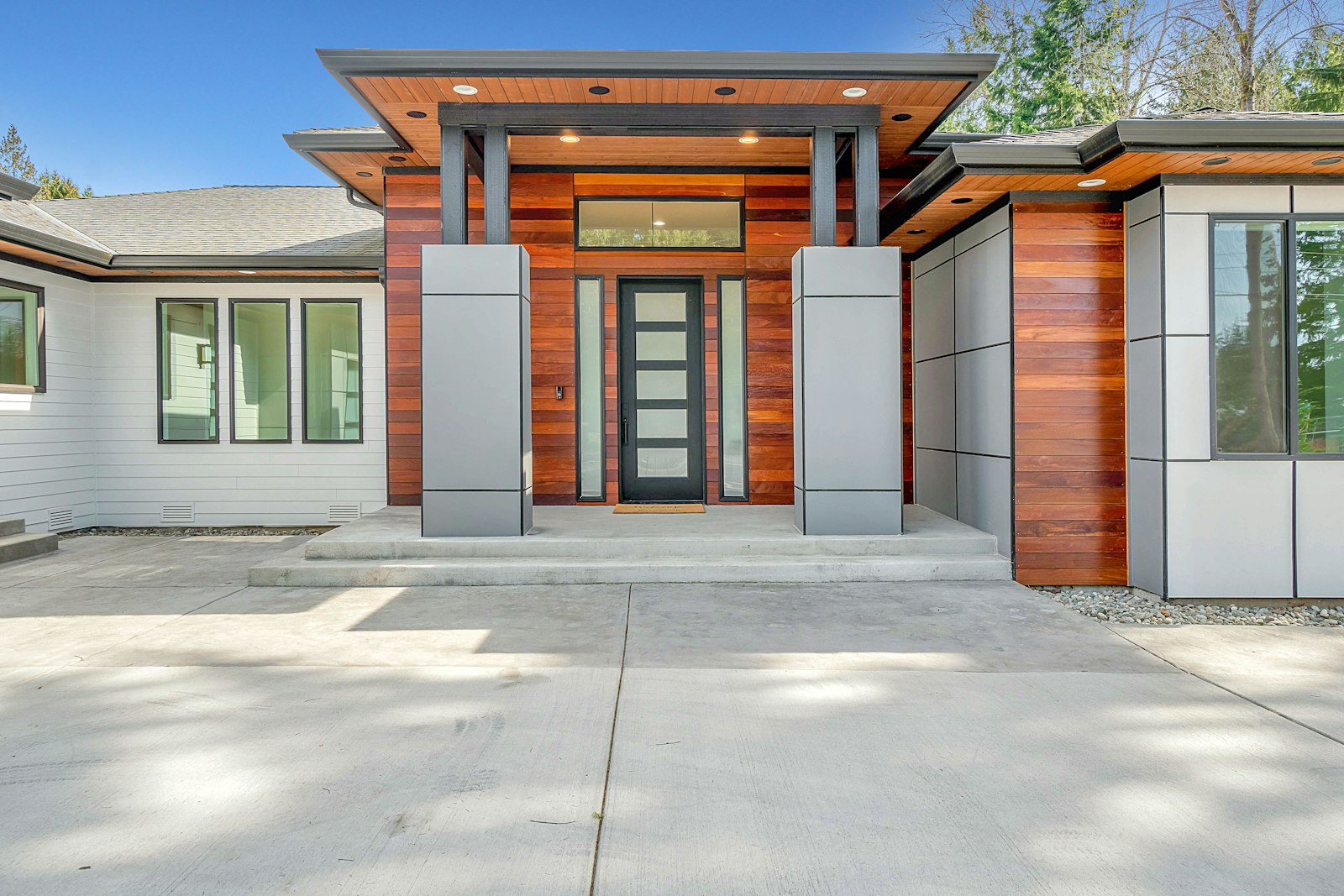
Metal siding has moved from industrial parks to some of the best-looking buildings in the Lower Mainland, and "metal" now covers a family of very different systems at very different prices, a woodgrain plank that passes for cedar at arm's length, composite panels flat enough to mirror a sunset, and corrugated steel doing farmhouse duty in Langley. This guide sorts them: what each system is, where it belongs, what drives its cost, and how to think about metal against the other claddings in our siding guide for BC buildings. If you already know you want metal and need an installer, see our metal cladding service in Vancouver.
Why metal earns its place here
Start with what all the systems share. Metal does not rot, which in a region where rot is the defining wall problem is not a small point. It does not feed mould or insects, holds finishes for decades, and is non-combustible, a code advantage on multi-family buildings and increasingly a wildfire-interface consideration. It is also fully recyclable and often carries recycled content, which matters on projects chasing green credentials.
The honest trade-offs: metal costs more than vinyl and most fiber cement applications, its crisp look punishes sloppy installation, everything telegraphs through a flat panel, and its performance depends entirely on the assembly behind it. Metal walls are rainscreen walls by definition: the panels shed most of the water, and the membrane and cavity handle the rest. If those words are unfamiliar, our rainscreen explainer is the prerequisite reading, because no metal system fixes a wall that cannot drain.
Longboard: the wood-look flagship
Longboard is an extruded aluminum plank system, and extrusion is the key word: these are thick, rigid architectural planks, not bent sheet. The woodgrain finishes are the reason it took over the region's high-end soffits and feature walls, from the street they read as flawless clear cedar, and they keep reading that way for decades without a drop of stain.
Where cedar demands the maintenance cycle described in our cedar maintenance guide, Longboard asks for an occasional wash. Where cedar chars, Longboard is non-combustible, which is why you see it on multi-family buildings where code restricts combustible cladding but the architect wants warmth. Dark woodgrain Longboard soffits over a charcoal body has become the signature North Shore look, and we install a lot of it exactly that way: warmth at the entry and roofline, tougher field cladding elsewhere.
Cost positioning: premium. Longboard is a deliberate choice for the elevations and details where its finish is seen and touched, which is why it so often pairs with James Hardie field walls rather than wrapping entire houses. Our deeper dive on the product line lives in the Longboard aluminum siding guide.
Flat panel systems: the modern facade
Flat metal panels, aluminum composite (ACM), solid aluminum plate, and steel panel systems, are the language of contemporary commercial and multi-family design: large smooth planes, crisp reveals, minimal visual noise. Within the family, the big split is between composite panels, two aluminum skins over a core, delivering exceptional flatness for big elevations, and solid sheet, simpler and often more economical but more prone to oil-canning, the gentle waviness visible on large flat areas in raking light.
The other defining choice is joint philosophy. Route-and-return cassette systems with concealed fasteners give the cleanest look at the highest labour cost. Exposed-fastener flat panel is honest and economical, right for industrial and workshop aesthetics, wrong for a luxury lobby. And open-joint rainscreen designs, where the gaps between panels are deliberate and the waterproofing lives behind, are their own discipline, covered in our guide to open-joint rainscreen cladding, and they are only as good as the membrane detailing you cannot see when the wall is done.
Flat panel is where design intent and installation quality are most tightly coupled. Panel layout gets drawn, reveals get dimensioned, and the crew either holds those lines across a whole elevation or the building advertises that they did not, forever.
Corrugated and profiled: the workhorse with a fan club
Corrugated and ribbed steel panel is the budget end of architectural metal, and it has quietly become a designer favourite: the profile adds stiffness, the shadows add texture, and the price adds nothing like Longboard's. On the right building, a laneway house, a modern farmhouse gable in Langley, a workshop that wants to look sharp, corrugated in a matte charcoal or weathered zinc-look finish outperforms its cost class dramatically.
Its rules: exposed fasteners are part of the look, so their layout deserves the same care as the panels; profile orientation changes both the aesthetics and the drainage; and cut edges and penetrations need proper treatment, coastal air finds untreated steel edges. Galvanized and Galvalume substrates with baked finishes handle our climate well; bare or poorly finished steel does not, and the distinction is the difference between the twenty-year wall and the streaky one.
Standing seam, the raised-seam profile from metal roofing, also appears on walls as a premium vertical look. On walls its concealed clips and clean vertical lines sit visually between corrugated and flat panel, and it deserves an experienced installer for the same reasons both of its neighbours do.
What actually drives metal siding cost
Across every system, the same levers move the number, the metal-specific cousins of the factors in our Hardie cost guide. System and finish: extruded plank and concealed-fastener systems up top, exposed-fastener profiled sheet at the entry level, with woodgrain and specialty finishes carrying premiums over solid colours. Complexity and trim: metal's crisp look comes from custom flashings, every corner, reveal, window return and termination is a fabricated piece, and busy elevations multiply them. Substrate and layout: composite panels need flatter substrates and drawn layouts; corrugated forgives more. Access and scale: staging for multi-storey work, and the efficiency curve that makes metal price better per square foot on large simple elevations than on small chopped ones.
And the assembly behind, always: membrane, cavity, and on many projects continuous insulation, which pairs naturally with metal systems because the sub-framing already exists.
Where each system belongs
A field guide, compressed. Longboard: soffits, entries, feature walls, multi-family accent bands, anywhere warmth meets a no-maintenance mandate. Flat panel, concealed fastener: contemporary commercial facades, multi-family upper storeys, homes designed in that language. Corrugated and profiled: modern-rustic homes, laneways, workshops, budget-conscious moderns, valley buildings that catch real weather. Standing seam walls: premium verticals on contemporary builds. Mixed systems: most of the best projects, metal where the design earns it, fiber cement or other cladding on the field, one crew flashing the transitions between them.
That last point is the practical one for anyone hiring. Transitions between materials are where water gets in and where finger-pointing between trades gets expensive. We install the full metal cladding family alongside our siding systems precisely so those joints belong to one accountable crew.
Finishes, and how metal ages here
The finish system on architectural metal deserves its own paragraph because it is most of what you are buying. Quality systems carry factory-baked coatings, with high-performance fluoropolymer finishes (the PVDF family) at the premium end, prized for fade and chalk resistance measured in decades, and polyester-class coatings at the economical end, entirely serviceable on less exposed elevations. Woodgrain finishes like Longboard's are multi-stage baked processes, not films or laminates, which is why they survive sun that destroys imitations. Ask any metal quote two finish questions: what coating system, and what does its warranty actually cover, colour retention and chalking numbers, not just "the finish."
Aging behaviour is where metal repays the premium. It does not rot, feed moss, or swell; its failure modes are cosmetic and slow: gradual colour drift, chalking at end of coating life, and on steel systems, edge creep at untreated cuts if the installer was careless. Coastal notes: within serious salt exposure, direct waterfront in West Vancouver, White Rock, aluminum outperforms steel and rinsing regimes matter; everywhere else, an annual wash is the entire maintenance program. Dents remain the honest caveat, less than the aluminum siding of the 1970s, more than nothing, which is why ground-contact zones deserve tougher profiles or different materials by design.
Maintenance and repair, the short honest version
The maintenance list: wash annually, keep sprinklers off the wall, touch up any site-cut steel edges per the manufacturer, and inspect sealant joints at penetrations on the same fall walk-around every cladding deserves. Repairs follow the systems' logic: plank systems like Longboard replace piece by piece much like other planked claddings; concealed-fastener panel systems repair at the panel level but want their original installer's literacy, cassette systems disassemble in order; corrugated repairs are the simplest, one more argument for it on working buildings. The matching story is far kinder than vinyl's: finishes hold so well that a five-year-old wall and a new panel usually sit together without comment, and the industrial colour ranges are stable across years. Our repair series covers the decision logic that applies when impact damage meets insurance, and metal's documentation, system, profile, finish codes, is worth filing at install for exactly that day.
Metal against the alternatives, briefly
Against fiber cement: metal is lighter, non-combustible like Hardie, crisper in modern languages, and more expensive in most applications; Hardie wins whole-house value and traditional looks. Against vinyl: different leagues, vinyl wins price, metal wins everything else. Against wood: metal is what you choose when you love wood's look and are done with wood's demands. Against stucco: metal brings drainage-friendly detailing and modern lines where stucco brings monolithic texture, and in our climate, metal's assembly is usually the easier one to keep dry.
A buyer's sequence for a metal project
Because metal projects reward planning more than any cladding class, the sequence that produces happy outcomes, drawn from our installs across the region. Start with the elevation map: which faces are feature, which are field, where do people touch the building, where does the sun rake. That map assigns systems and budgets before any brochure opens. Second, resolve the assembly: cavity depth, membrane strategy, insulation ambitions, because sub-framing decisions constrain panel choices and Step Code targets are cheapest to hit when planned here. Third, choose systems and finishes against the map, sampling large pieces outdoors, metal finishes shift with sky conditions even more than paint. Fourth, get the layout drawn for any flat-panel elevations: reveal widths, panel modules, how openings centre in the grid, the drawings are cheap and the arguments they prevent are not. Fifth, interrogate the details: corner conditions, base terminations, penetration treatments, transition flashings to neighbouring materials. A quote that prices "metal siding" without drawings and details is pricing a different project than the one you imagine, the metal-specific version of the vagueness our contractor guide warns about.
Where metal is heading here
Worth knowing as you choose: metal's share of Lower Mainland exteriors is growing for structural reasons, not fashion ones. Code pressure toward non-combustible cladding on larger buildings, wildfire-interface awareness pushing the same direction at the region's edges, the maintenance mathematics of strata budgets, and the design language of the housing being approved, mid-rise, infill, laneway, all point the same way. That growth is why finish ranges keep widening, why woodgrain technology keeps improving, and why the installer pool is deepening beyond the commercial specialists who once owned the trade. For a homeowner or developer choosing today, it also means the resale story is comfortable: a well-detailed metal elevation reads as current now and durable later, and the product families above all have the track record to back the read. The buildings this region is proudest of increasingly wear the stuff, which is its own quiet argument.
Key takeaways
- "Metal siding" is a family: Longboard woodgrain planks, flat panel systems, corrugated and profiled sheet, and standing seam walls each solve different problems at different prices.
- Every metal wall is a rainscreen wall: panels shed, the membrane and cavity behind decide the outcome, and transitions between materials deserve one accountable crew.
- Finish system is most of the purchase: ask for the coating class and its colour-retention warranty, not just "the finish."
- The winning pattern in this region is mixed cladding: metal where the design earns it, fiber cement on the field, budgets concentrated where buildings are actually seen.
- Corrugated is the sleeper value; Longboard is the premium signature; flat panel demands drawings and discipline, and rewards both.
If a metal system is on your shortlist, or should be, book a free assessment or call 778-358-2885. We will match the system to the building, the budget and the elevation, and tell you plainly where metal is worth it on your project and where it is not.